Barring two people whom I had seen during two weeks in Israel, I hadn't seen anyone I knew (much less anyone I was related to) face-to-face for the prior eight months! Family reunion! We met in the "lobby" of our hotel in Rome - Hotel Continentale on Via Palestro nearby to the train station.
They basically had traveled all of the previous night and had gotten little sleep, but time while traveling is precious so we set out immediately for our jam-packed day of sight-seeing.
We headed Southwest toward the Roman Forum.
My family and Caesar pose for a reunion picture - it's been a long time since we've seen Caesar.
We would wind around back at the Ancient Roman sights/sites after the Synagogue, but we couldn't help but get distracted by some of them along the way. First there was Trajan's Column.
I assume that guy at the top of the column is Trajan.
The column depicts the military victories of Trajan in a continuous spiral relief sculpture that spans every inch of the cylinder which is very impressive.
What a relief!
It's really lucky that Trajan's Column was the one that survived - these other ones weren't nearly so impressive.
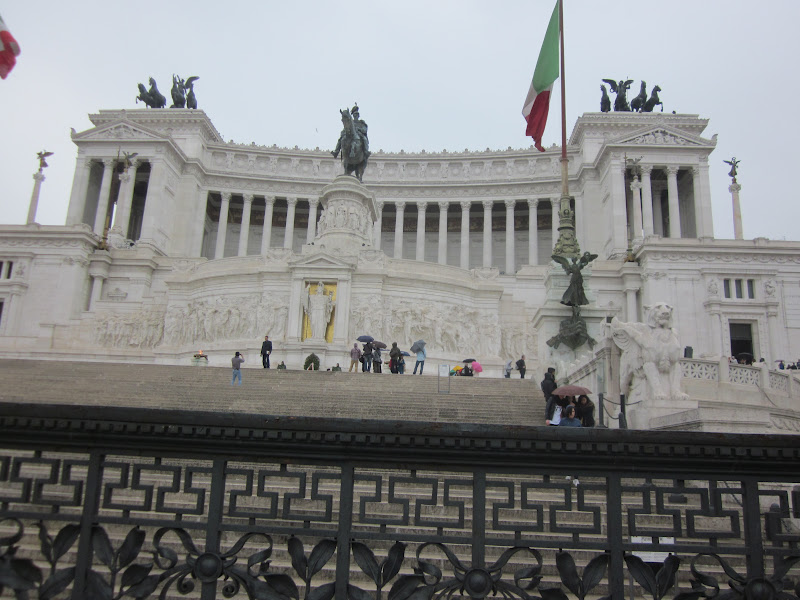
Trajan's Column is just off of the Piazza Venezia which is dominated by the National Monument to Victor Emmanuel II which contains the tomb of the unknown soldier or so I've read - we didn't go in, but walked in front of it.
It's very nice.
While we were walking through that Piazza (public square/plaza) it started to rain so my mom took shelter en route.
Ilana was better equipped to handle the rain - dad got wet.
We photograph well.
Realizing we didn't want to get too wet not yet having begun our scheduled activities for the day, we ducked into the first of many churches into which we were to duck over the course of the trip. Most churches are nice to look at:
It quickly became clear that mom's favorite parts of Italy were going to relate to Judaism.
Unfortunately, it is forbidden to take pictures within most Synagogues in Europe and those in Italy were no exception. This is because there are more security risks over there with the elevated hate crime levels across the continent.
Someone on the internet broke the rules, but I'm glad they did because the sanctuary was beautiful.
The Synagogue is still in use and regularly, but for most of the week it is used as a museum with guided tours to the sanctuary every hour or so. The museum was nice. Most interesting was the row of many Torah covers designed with various patterns of cloth. We learned later on our tour that the Jews of Italy were forced to only work in a few professions, one of them being traders of used textiles - so a common donation to the Synagogue were ornate Torah covers fashioned out of the used textiles many of the Jews handled daily.
After the Synagogue, we walked two blocks away to the main street of the former Jewish Ghetto of Rome where there is now a wealth of Kosher restaurants and Judaica shops. One delicacy they had in plenty was artichokes - I wonder if that is because there was a particular affinity for artichokes in the Rome Jewish community, or if artichokes are just popular in Rome - either way they were delicious.
Being a tourist is hard on the legs - so we taxied to the Coliseum after our lunch in the Jewish Ghetto.
There it is!
Note: The ancient Roman amphitheater in Rome can be spelled either Colosseum or Coliseum.
The Colosseum was a Roman amphitheater used for entertainment. Entertainment in Roman times consisted infinitely more of killing human beings in one way or another than today. The wait to enter the Colosseum can be well over an hour, but if you are on a guided tour, which costs a few euros extra, one can bypass this wait in addition to receiving the tour. I would have no reference point from which to compare our tour to any others that are privately provided, but the tour provided by the Colosseum ticketing booth was top notch. We were granted access to the reconstructed portion of the original floor of the amphitheater and to the topmost accessible story of the structure, so I'd assume it's better than the private tour companies trying to sell tours outside the entrance.
Once inside, we had some time to kill before our tour started (but at least we weren't still standing in line). Ilana and i took some great pictures of each other next to a wall.
Then we asked our dad to take a picture with the wall, so he did this:
bahaha.
As I said, the tour was very good. First we went to the reconstructed stage area and heard about all the different games played at the Coliseum, and by "games" I mean different methods of having people fight each other/animals to the death.
Those arches in the background lead to the concession stands where the ancients sold nachos/all-beef hot dogs.
I remember learning in high school Latin class that they would flood the Coliseum with water and stage naval battles inside the bowl of the stadium, but I never believed it. Even our tour guide who mentioned that it was thought by historians that they did this, admitted that no one knows how they wouldhave done it. I think what happened was some ancient Roman was trying to write in his 1st Century C.E diary how awesome it would be if they flooded the coliseum with water and staged a naval battle, instead he wrote how awesome it was when they flooded the coliseum with water and staged a naval battle. Latin is very hard, it can confuse you very easily. I'm sure he was just confused.
See what I'm talking about? The water would leak out through all these holes!!
Over the many centuries, the Coliseum turned into a quarry where the people of Rome would come to strip building materials from its deteriorating shell. To preserve it, and to memorialize the Christians who died here, a Pope made it a holy site.
That's why there's a cross here.
You know what? I'm going to have to call you back... yeah I'm about to watch this lion totally eat a former slave.
The tour ended at the top level of the Coliseum's remaining walkways which is restricted to most visitors. The views were really great.
View back towards the Piazza Venezia.
This is the Roman Forum which was our next stop after the Coliseum.
See that little area of whitish grayish stones over the left portion of the stage area? Those are the last remaining marble seats of the Amphitheater.
The ticket that grants you access to the Coliseum also grants access to the Roman Forum, so doing them both in the same day is very convenient. We were realizing that touring all day on our feet can be very tiring so when we got to the Roman Forum, or as the Romans would spell it, the Roman Forvm, we had to have a seat:
We've all been taught that the Romans were great engineers, builders, thinkers, poets. What we were not taught, is that the Ancient Romans were total slobs! Look at the mess they left!
It's like they didn't clean up after themselves at all. No WONDER they call them "ruins"!
But seriously, it was cool to be in the former seat of Roman power, despite the mess. One major attraction was the Arch of Titus. Built in the year 82 to commemorate the Emperor's brother Titus's death. It depicts Titus's victories and in particular the conquest/siege of Jerusalem. It depicts Jews carrying the Menorah of the Holy Temple to Rome in submission. When the State of Israel was established, local Rabbis paraded the local Jewish Community in the opposite direction as the depicted march - signifying a return from the diaspora.
Still Jewish!
There it is.
For scale:
Other than depicting Jews as slaves - it's a pretty impressive arch.
In true Roman slovenly fashion, some Roman left three steps of a staircase lying around so we played with that for a while:
I was entertained...
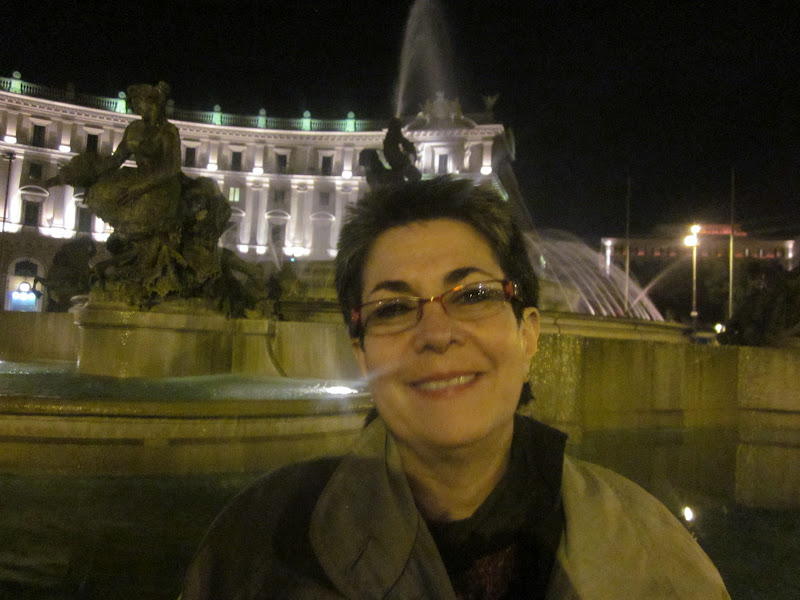
Exhausted, we taxied back to our hotel on Via Palestro. Unfortunately, due to our hotel's proximity to the center of Rome, we were not going to be spending much time in the public squares at night, which are supposed to be very beautiful and lively. Instead, after having dinner nearby to our hotel, we strolled down to the Piazza della Repubblica, and although it's no Piazza Navona - it was still beautiful.
Israel was nice, but it was time to move on. I met up with my parents and younger sister in Italy for a fantastic nine day trip. It made more sense for me to fly in Sunday morning and for them to arrive on Monday, so I began the trip alone - therefore I consider this post a prologue to the actual trip even though I did a lot of fun things that day.
After having been up all night in the Tel Aviv Ben Gurion airport and after an airline mix up which left me having to buy a carry-on sized bag in the airport itself I arrived in Rome. Despite the mix-up, Ben Gurion Airport is extremely nice and I consider it a model for how airports should be arranged.
Upon entering the baggage claim/ground transportation area of the Rome airport, I followed the signs to the bus ticket vending window. It costs four euros to ride a coach bus to the central train station of Rome. From there I took a cab to my hotel - the Best Western Astrid - pretty far north along the East bank of the Tiber river. It so happened that that day was the day of the Rome marathon. Luckily the marathon route didn't obstruct my taxi driver (the nicest taxi driver in all of Italy who gave me an English language tourbook of Rome someone had left in his car) from taking me to the hotel.
Although I was very tired, I did not want to waste any of my time in Italy at all, so I started walking toward the sights - snapping pictures of the marathoners along the way.
You can do it!
I'm not so used to marathons taking place so close to such beautiful churches.
Go! Go! Go!
And then I saw the Vatican! The biggest church in the world! It was mind-blowingly cool.
Could you ask for a cooler finish line?
Almost there!
OK turns out the marathon didn't end at the Vatican like I thought it did. In the picture below, which is the same stretch of the race as depicted above only facing away from the Vatican you can see they veer away.
Disappointed from thinking I was going to see the finish line, I decided to visit St. Peter's Basilica. Pictures do not do the place justice. It is something one must see in person to appreciate. Unlike what people think of as classic renaissance church design, the ceilings are mosaics (pictures made of different colored tile) instead of frescoes (paintings). Entry to the Basilica is free, but in most cases visitors do have to stand in long lines to get through security on the north end of St. Peter's square to get in as I did.
Breathtaking. Keep that golden ring near the top of the picture in mind for later.
Once inside, immediately on your right you see Michaelangelo's Pieta- one of the many scenes from the bible I was about to see very often over the following ten days.
My camera was dying - not enough juice to try several times to get a clear picture. Anyway - it's behind smudgy glass... just google it.
I strolled around the Basilica. When I had finished doing that it was time to climb to the top of the dome. You may ask, "but Josh, how can you climb to the top of the most imposing landmark in Rome?" Well I'll tell you. What you'll want to do is head out of the front entrance to the Basilica and turn left back towards the security entrance. Once past the north wall of the entryway to the basilica turn left again and head down the alleyway to get to the entrance to the cupola tour (cupola means dome).
It costs €5 total to climb the stairs the entire way and €7 total to take the elevator halfway up to the roof of the Basilica and then up and down the cupola by stairs, then back down to ground level by elevator. I highly recommend the elevator. I've read that there are no views along the way up to or down from the roof of the Basilica and it's just adding exercise to an already strenuous climb.
Stairs are hard if they're not a cardio motion you're used to, and in Afghanistan I probably averaged about five stairs per day for the entire seven months I was there. I've climbed various other stair-centric tourist attractions and I knew I was going to be sore before I began - so yeah - elevator is the way to go.
There are endless spiral staircases up through the lattice-work of the dome. I'm surprised that they allow tourists to even go up there considering the risks of a pileup or a missed step leading to a bunch of broken legs - although there are emergency buttons you can press at most of the many landings along the way. The views of Rome from the top were yet to come, but first I came upon the inner ring of the cupola. Here I was looking down into the basilica. These pictures might help someone who has never been comprehend the sheer scale of this church. Once again my camera's battery was dying and there's a chain-linked fence keeping those at this level behind the railing.
Remember that gold ring from earlier? Now I'm above it.
After that landing you continue to ascend through the dome structure - the stairway leans more and more inward accounting for the curvature of the dome until you're climbing with your body nearing a forty five degree angle - then the direction switches and instead of back and forth, you're at a point where the incline of the staircase turns directly inward and upward toward the very top of the dome where you get the best view of anywhere in Rome!
That crowd in St. Peter's square seems to be growing...
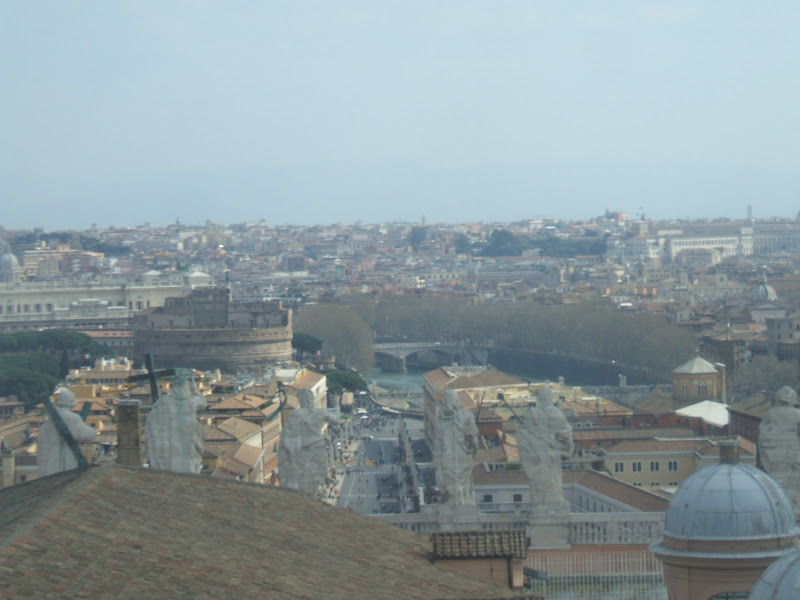
Back down at the roof level I took a few more pictures of the surrounding areas.
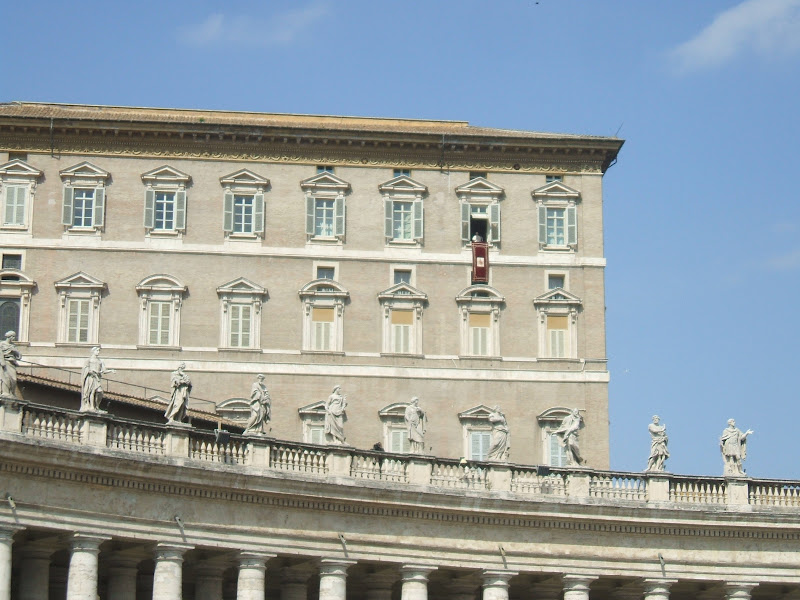
And that's what it's like to climb St. Peter's. My legs were very shaky and tired at the end, but this climb is worth it. As I walked back into St. Peter's Square everyone started applauding! I thought, "Wow, Rome really knows how to welcome a lowly tourist!" and then the speakers rang out in Italian. Pope Benedict XVI was addressing the masses from the papal apartments. It was a Sunday during lent so it warranted a special sermon from the Pope himself! This explained the gathering crowd in the square.
See that little mauve drape thing under that window - that's the pope above that!
The Pope spoke mostly in Italian, but in total he spoke six languages including Latin, Spanish Russian, English, and German. Very impressive.
The crowd.
Thanks for all the blessings, Papa!
The legend of the founding of Rome revolves around Romulus (the founder of Rome - note the similarities in the names) and Remus being raised by a she-wolf. Concordantly, this subject is often depicted in art throughout Rome and all art museums in and out of Rome.
mmm... wolf milk.
By the time I finished soaking up some Vatican views, I was truly exhausted. I strolled back up the Tiber toward my hotel and as I walked snapped a couple more pictures of the stragglers in the marathon, disheartened at how little it turned out I knew of the route the race takes through Rome. I passed out in my hotel and got some much needed sleep.
Clowns running a Marathon.
Now they're running into a tunnel? I don't know this city at all... yet...
Much of my second week in Israel was spent staving off boredom as most of the people I was spending time with were consumed with their first week of internships. Invariably, there were several people whose internships had not started yet with whom I spent the majority of my time. One such unemployed person came to me one day with the suggestion that we go "volunteer" at the Tel Aviv Animal Shelter. By volunteer, what I mean is play with an adorable puppy for a while.
Here we are!
The Tel Aviv Animal Shelter (more formally The Society for Prevention of Cruelty to Animals in Israel), is exactly what it sounds like. It's a home for abused, or unwanted animals of a seemingly wide variety (mostly dogs). We found the perfect dog to volunteer with. Here he is:
I love dogs though I'm not sure I would make a very good dog owner. Our dog, who we named Rufio was having me rethink that. He was so affectionate!
awwwww.
So what you do is basically take a dog out on a leash in their little courtyard thing that has enough room to walk/run around. There are doggy treats, and some toys to play with - pretty standard dog shelter stuff.
At this point I'd say I've used enough pictures of one thing for one blog post - but he was just so damned cute! I'll have to make an exception. After about a half an hour, another volunteer with another dog came close to us and Rufio barked at them like they were trying to attack us. He was protecting us! At this point we were anticipating some separation anxiety.
In my opinion, no trip to Israel is complete without a visit to Jerusalem. This trip, in relation to the other times I've visited Israel, was decidedly not Jerusalem centered. I enjoyed my experience in Tel Aviv overall, and it was nice to spend lots of time on the beach and see secular Israel, but I'm much more of a Jerusalem guy than a Tel Aviv guy.
I went with my good friend Seth who is in Israel on a Masa Program to see the sites I had seen many times before, but am always excited to see again.
We started by taking the 405 bus from the Central Bus Station in Tel Aviv to the Central Bus Station in Jerusalem. From the CBS in Jerusalem, we took the newly completed light-rail directly to the North Gate of the Old City - the Damascus Gate. Entering this gate headed south puts the Christian Quarter on your right and the Muslim Quarter on your left.
We continued south and took a quick look at the Church of the Holy Sepulchre. This church encompasses the sights where Christians believe Jesus to have been crucified, buried, and resurrected. The several final stations of the cross on the via dolorosa are within the church itself.
There it is.
Site of the crucifixion.
Churches are usually pretty nice looking.
The tomb where Christians believe Jesus was buried and came back to life.
OK this church was established in the 300s by Constantine (most people know him as the guy who converted the Roman empire's religion to Christianity)'s mother Empress Helena. After Constantine changed the official religion - she went on a mission to the holy land to "find relics". She came back to Rome having "found" the true cross, the holy tunic, the nails of the crucifixion, as well as the sites of various important points in Jesus's life such as the site of the nativity, and the place where Jesus was crucified.
It's a little funny to me to imagine her walking the streets of Jerusalem and pointing to the stations of the cross along the road, "and that's where he fell, and that's where Simon the Syrene helped him carry the cross, and that's where he was crucified... and so on". Archeologists believe that the site of the Church of the Holy Sepulchre was once the site of a Roman temple so really it's more like she was sent to convert the holy land into the new religion of the empire - in the same way that late December became Christmas because there was a Roman holiday at that same time of year. I find it hard to believe that basically any of these churches marking the important points mentioned in the bible are actually in the right place, but I understand the Christian desire to have these actual churches erected - it makes it more relate-able that they are walking in the same places as Jesus once walked.
The church itself is shared between the sects of Christianity that are prominent in Jerusalem. These sects have shared responsibilities and prayer times within the church for more than a hundred and fifty years. Every once in a while the status quo of this shared status is tested by something most people would consider to be very minor. A door is left open, a guy moves his chair a few feet to the left - things like that, and a fist fight breaks out between the sects. I think it's pretty funny.
After visiting that church we backtracked a little bit and passed various stations of the cross along the via dolorosa. Here's a picture of one of those:
I think it's one of the two stations that mark where Jesus fell while carrying the cross.
We were backtracking to make our way to the Austrian Hospice. Not hospice like a hospital, a hospice is also like a hostel and generally intended for use by people of a certain religion. The Austrian Hospice in Jerusalem has been in use since 1863.
If you know where it is (it's at a point along the via dolorosa) and if you ring the bell they will buzz you in. Once inside - say hello to some German speakers if you must but then - climb the stairs to the roof! It's a great view of the old city from inside of it!
Wow that was fun. After that, we started heading toward the Western Wall. Along the way I had to take this picture:
OSU v. Michigan.
So the Western Wall is the closest bit of retention wall holding up the Temple Mount to where the Jewish Temple once stood that is open to the public. It's forbidden to more observant Jews to go up to the Temple Mount lest they stand in the spot where the Holy of Holies once stood because that exact spot isn't known, BUT since the Holy of Holies is the aptly named holiest spot in Judaism, Jews pray towards it, and since this is the closest permissible spot to stand and pray - it's a popular prayer spot. Sorry if that was complicated.
Well - it's usually popular. Sometimes there are lull periods like this one.
Spent some time at the Wall, then, by chance the Temple Mount was opening up to tourists so we went up there. Tourists are only allowed up to the Temple Mount at very odd hours and only at the entrance ramp made of wood visible from the Western Wall prayer plaza. Muslims are allowed to go there by various other entrances, but there are Israeli guards stopping people who don't look Muslim - pretty much the most racially profiling job of all time. I look very local in the Middle East so I probably could have made it in, but Seth looks White - thanks a lot, Seth.
As a tourist, you're not allowed to enter the Dome of the Rock or the Al Aqsa Mosque, but the Temple Mount itself is very pretty.
This kid was having a temper tantrum.
Temper Tantrums are pretty much the same in every language.
See? It's pretty.
Then we took very tourist-y pictures like this one.
Seth.
From the Temple Mount, you have a great view across a valley towards the Mount of Olives. Half of this hill-face is completely covered with the graves of thousands upon thousands of Jews. The graves are strategically placed. Jewish tradition holds that when the Messiah comes, the dead will wake and live in a Paradise. The people who are buried there are in a prime spot for when that happens - right there facing Jerusalem!
Also on the Mount of olives are various other Churches dedicated to specific events mentioned in the new testament. This picture shows three of them with the giant cemetery just visible at the upper right of the photo.
Lower left to upper right: Church of Gethsemane, The Church of Mary Magdalene, and the Church of Dominus Flevit.
Gethsemane is mentioned in the bible as the garden where Jesus prayed the night before his crucifixion. There's a garden next door to the church with many trees hundreds of years old - perhaps not 2000 years old, but this is the traditional Gethsemane garden. The Russian Orthodox church of Mary Magdalene is very clearly Russian - lots of different nations make their mark like this one on Jerusalem. My history of Jerusalem teacher said that Jerusalem is like a beautiful woman that nations try to woo by giving her beautiful jewelry like this. Interesting way of putting it... Anyway this church is also only open at odd hours like the Temple Mount (I went there back in 2008). The church contains a relic of the pinky bone of the Saint Mary Magdalene herself, but don't ask me about its authenticity... Finally the church of Dominus Flevit marks the passage of the bible where Jesus looks upon Jerusalem and weeps (dominus flevit means "and the lord wept" in latin) because he foresees the destruction of Jerusalem - and so the church is shaped like a tear. That church is tiny. Basically it's a 20 foot square chapel.
After leaving the Temple Mount, we started heading towards modern Jerusalem, after first spending some time in the Jewish Quarter - taking in some sights and eating some shawarma, we headed towards the King David Hotel. This is one of the oldest and most luxurious hotels Israel. Since its opening in 1931, it has hosted royalty from all over the world - presidents, prime ministers etc. The headquarters of the British mandate was housed here - this one scene from the awesome film Exodus was filmed and took place here. Paul Newman and Eva Marie Saint had Martinis there - so we ordered some Martinis on the terrace which also has an incredible view of the old city.
To industry!
To the sun never setting on her majesty's empire - oh wait...
After our classy drinks and what had become a lot of time on our feet, we were ready to be done. There was just one more sight I had to see. The Time Elevator. The Time Elevator is the most kitschy, corny thing you could possibly do in Jerusalem - and I hadn't done it yet. I had waited for this moment for years. Basically, it's one of those movies with the moving seats that make people nauseous. You are in a malfunctioning time machine that Chaim Topol - the actor who played Tevye in Fiddler on the Roof - helps to navigate back to the present by showing you around the history of Jerusalem, and YES - it is exactly as awesome as that sounds.
After the incredible experience at the Time Elevator, we made our way back to the Jerusalem Central Bus Station and hopped on a bus back to Tel Aviv. We really did see the highlights of Jerusalem tourism in one day of touring - which is a feat! Take it away, Bender!